Chinese Startup Aims to Launch AI-Powered Laser Mosquito Killer After Raising $2.7M
June 28, 2026
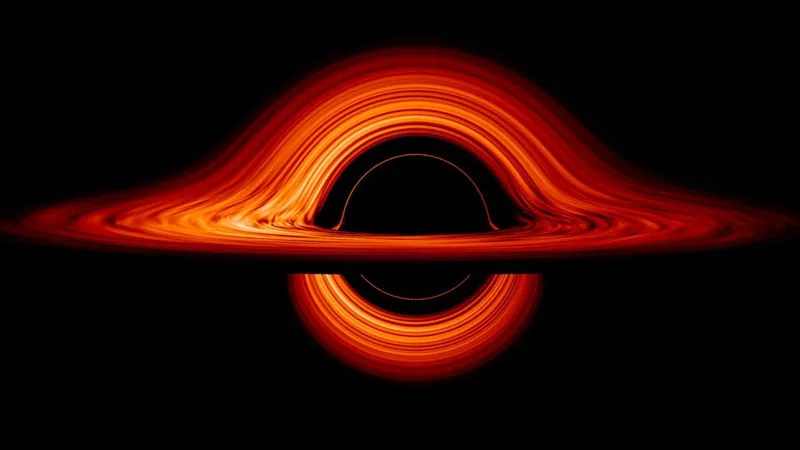
The event horizon of a black hole, traditionally regarded as a purely mathematical boundary, has been physically traced for the first time by scientists. Previously, this boundary—defining the point of no return beyond which matter and light cannot escape—was only inferred indirectly through calculations based on the black hole’s mass and spin.
Until now, the event horizon was understood as an abstract concept without tangible evidence. Researchers relied on theoretical models and complex simulations to understand this elusive threshold. However, the advent of advanced gravitational wave detectors has marked a turning point in black hole studies.
Gravitational waves, ripples in spacetime generated by massive cosmic events, have become a critical tool to probe the regions near black holes. These waves carry rich information about the dynamics of black holes, including the characteristics of their event horizons. Scientists have now utilized data from these detectors to identify material traces that correspond to the event horizon itself, rather than just the black hole’s properties.
This breakthrough bridges a significant gap between theory and observation in astrophysics. By detecting physical features linked to the event horizon, researchers gain a more direct understanding of black holes’ nature and behaviors. This advancement also opens new avenues to study phenomena involving extreme gravity and the fundamental fabric of the universe.
While detailed technical descriptions and subsequent implications of these findings are still being explored, the discovery represents a pivotal moment in space science. It enhances the comprehension of black hole physics and validates long-standing theoretical models with empirical evidence.
The progress underscores the increasing importance of gravitational wave astronomy as an observational science, complementing traditional electromagnetic approaches like optical and radio telescopes. As gravitational wave detection technology continues to improve, it is expected to reveal further insights into the universe’s most enigmatic objects.
This milestone offers exciting prospects for future research in astrophysics, potentially impacting our understanding of cosmic evolution and the underlying laws governing space and time.
For the first time, researchers have identified physical evidence linked to a black hole’s event horizon beyond theoretical models.