
Memory Chip Shortage Drives Up Prices in Automotive Industry
July 23, 2026
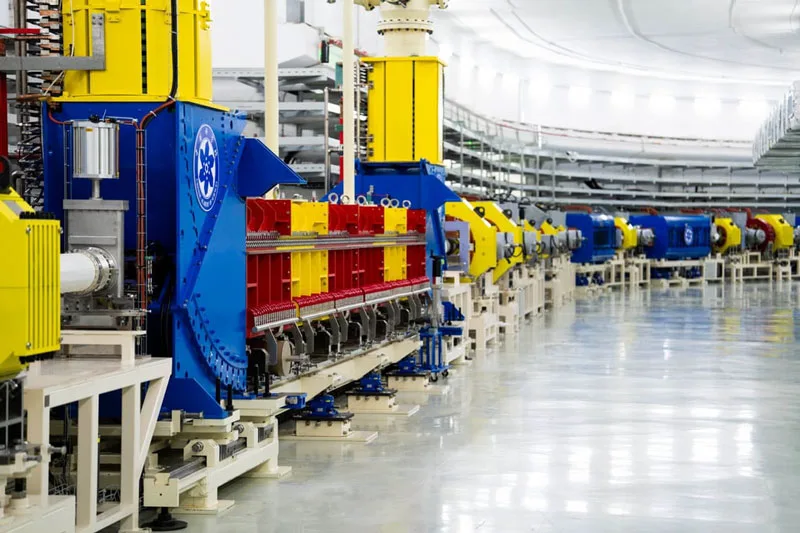
Chinese scientists have completed construction of the High Intensity Heavy-ion Accelerator Facility (HIAF) in Huizhou, Guangdong province. This advanced complex is designed to generate ultra-intense beams of heavy ions, enabling the recreation of atomic-scale phenomena occurring inside stars and supernova explosions.
On July 21, HIAF passed its technological acceptance and transitioned into a phase of experimental operation, marking a significant milestone for research capabilities in nuclear and astrophysics. The facility represents a pioneering achievement in accelerator technology.
HIAF is the first accelerator complex worldwide to integrate a superconducting linear accelerator with ring accelerators, a configuration that facilitates the production of exceptionally powerful heavy-ion beams. This unique design enables researchers to investigate nuclear reactions and stellar processes with unprecedented detail and control.
Heavy-ion accelerators are critical tools for studying the fundamental behavior of atomic nuclei under extreme conditions, such as those found within stars. By mimicking these environments, HIAF allows scientists to better understand nucleosynthesis—the process by which elements are formed inside stars—and the mechanisms driving supernova explosions.
The successful commissioning of HIAF positions China among the leading nations in particle accelerator technology and astrophysical simulation capabilities. While specific operational parameters and experimental outcomes have not yet been disclosed, the facility is expected to play an important role in a variety of scientific disciplines, including nuclear physics, material science, and astrophysics.
As experimental campaigns progress, HIAF will contribute valuable data toward unraveling the complex phenomena governing the lifecycle of stars and the creation of heavy elements in the universe. The integration of superconducting technology also indicates an emphasis on advancing accelerator efficiency and performance at the frontier of research infrastructure.
This development adds to a global context where heavy-ion accelerators are increasingly employed for fundamental physics investigations and applied scientific research, spanning from energy production studies to medical isotope generation.
China has completed its High Intensity Heavy-ion Accelerator Facility, designed to replicate atomic processes inside stars and supernovae.