Russian Company Launches Second Batch of Satellites for Domestic Starlink Alternative
July 20, 2026
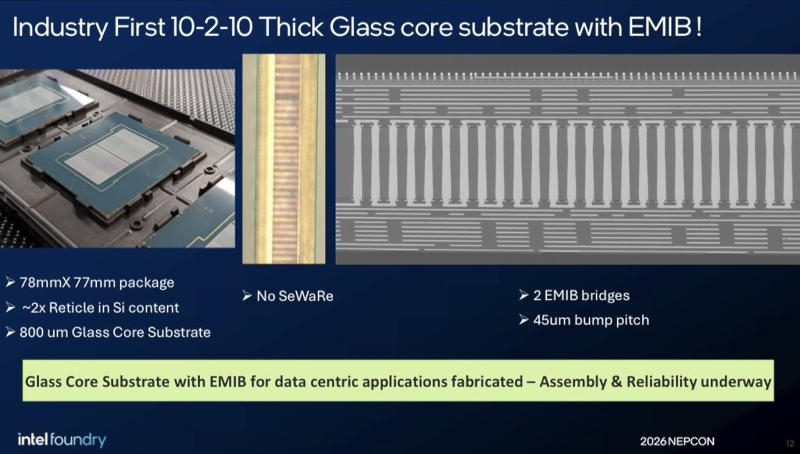
Intel revealed a new glass substrate technology at NEPCON Japan 2026 designed to advance the fabrication of chips used in artificial intelligence accelerators and high-performance computing (HPC) solutions. This innovation aims to improve the structural foundation for future semiconductor devices incorporating Intel’s Embedded Multi-die Interconnect Bridge (EMIB) technology.
The newly introduced glass substrates are engineered to support complex chip architectures, enabling enhanced connectivity and performance for AI and HPC applications. Intel’s approach focuses on leveraging the material properties of glass to achieve better thermal management and electrical stability in multi-die packages.
By integrating glass substrates with EMIB, Intel plans to facilitate higher component density and more efficient interconnects between heterogeneous chiplets on a single package. This advancement is expected to address some of the challenges posed by the increasing demand for scalable AI hardware and computing power in data centers and specialized accelerators.
Intel’s presentation at the industry event highlighted the potential impact of glass substrate technology in reducing manufacturing complexity while improving reliability and performance in sophisticated semiconductor devices tailored to AI and HPC workloads.
Intel’s glass substrate innovation joins ongoing efforts by semiconductor manufacturers to push the boundaries of chip integration and performance. Similar advancements in interconnect technologies and substrate materials are being pursued widely to meet the escalating requirements of AI computation and datacenter processing. Competitors have also been exploring new packaging and substrate solutions to support heterogeneous integration and improve chip scalability, emphasizing the critical role of underlying materials and interposer technologies in next-generation hardware.
Going forward, monitoring Intel’s progress with glass substrates alongside updates in EMIB and chiplet ecosystems will be essential to understanding the evolving landscape of AI and HPC semiconductor technologies.
Intel introduced a novel glass substrate technology to enhance chip manufacturing for AI accelerators and high-performance computing.