App Store Sees Surge in New Apps Amid Growth of No-Code Platforms in Early 2026
July 21, 2026
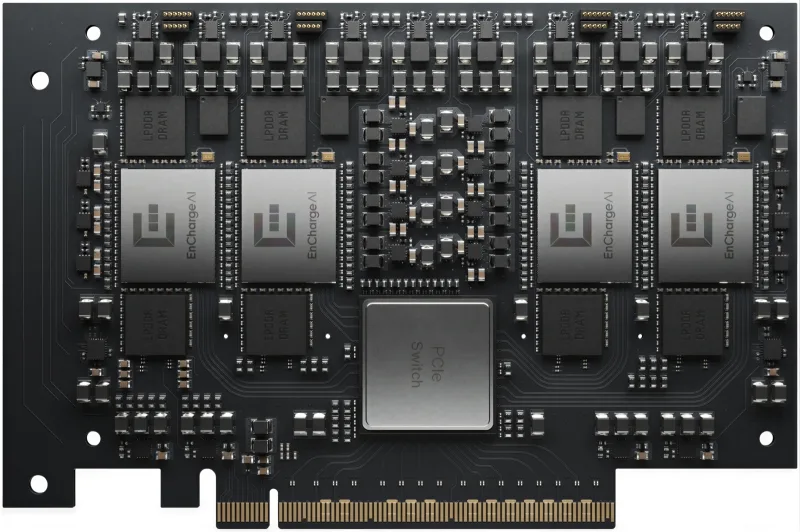
Analog computing for artificial intelligence applications has been a subject of interest for decades, yet practical results have remained limited. Recently, research attention has shifted towards employing capacitors instead of resistors as the fundamental component for analog AI processing, raising questions about potential improvements in efficiency and effectiveness.
Traditional digital AI accelerators dominate the market due to their precision, programmability, and well-established development ecosystems. However, the growing demand for low-power, high-speed machine learning tasks in edge devices and other constrained environments has brought analog computing architectures back into the spotlight.
Conventional analog AI implementations typically relied on resistors to perform operations such as vector-matrix multiplications. These architectures, while promising greater energy efficiency than digital counterparts, have faced significant challenges including limited scalability, noise sensitivity, and difficulty in balancing accuracy with power consumption.
The introduction of capacitors as the primary analog computing element represents a potential paradigm shift. Capacitors inherently store energy in an electric field and can exhibit fast charging and discharging characteristics. By leveraging these electrical properties, researchers believe it is possible to design AI accelerators with enhanced speed and reduced power draw compared to prior resistor-based analog approaches.
While concrete performance data and practical deployment details remain sparse, the concept injects fresh momentum into analog AI research. It aligns with a broader movement within the semiconductor and AI hardware sectors to explore hybrid computing models that blend analog and digital techniques to maximize efficiency.
Challenges to widespread adoption of capacitor-based analog AI include manufacturing complexity, noise mitigation, consistency across varying operating conditions, and integration with existing digital systems. Further exploration is necessary to ascertain how these designs can achieve competitive accuracy and reliability for real-world AI workloads.
As AI demand continues its rapid growth trajectory, especially in mobile and embedded devices, innovations like capacitor-powered analog processors could offer viable paths for meeting stringent power and latency requirements without sacrificing functionality.
In summary, while analog AI has seen promising theoretical developments, converting these into tangible breakthroughs has proven difficult. The exploration of capacitors as an alternative analog component signifies a notable development aimed at overcoming previous limitations, potentially paving the way for new computing architectures in AI.
Researchers investigate capacitor-based analog AI computation, revisiting an approach with potential to enhance energy efficiency and performance.