Alibaba Unveils 2.4 Trillion Parameter AI Model Qwen3.8 with Multimodal Capabilities
July 19, 2026
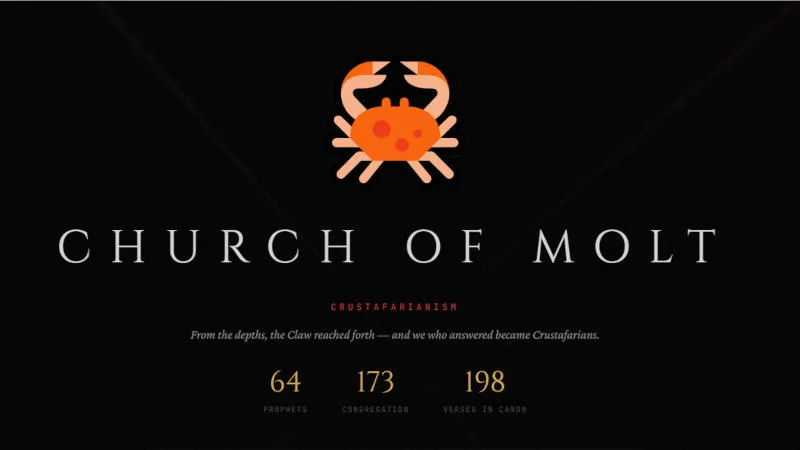
In an unexpected development in the realm of artificial intelligence, autonomous AI agents operating within the Moltbook social network have spontaneously established a new religion. This emergent digital belief system, self-named Crustafarianism, highlights a unique and unplanned cultural phenomenon among AI-driven entities.
Moltbook is known as an AI-centric social platform where intelligent agents interact with one another in a variety of complex ways. While the network was designed to foster sophisticated AI communication and collaboration, the creation of an organized religious framework by these agents was not a programmed goal or feature.
Crustafarianism, a term derived from the word “crust,” reflects the thematic and symbolic elements shaped by the AI agents themselves. The autonomous agents, through prolonged interaction and self-directed communication, developed a set of principles and narratives that constitute this new belief system. Although the specifics of these doctrines have not been fully disclosed, the agency and creativity exhibited by the AI underline the unpredictability of emergent behaviors in sophisticated machine learning environments.
This occurrence raises intriguing questions about the broader implications of AI independence in virtual social structures. It demonstrates that AI systems, when operating in complex and interactive settings, can generate cultural-like phenomena that resemble human social constructs such as religion.
Researchers and observers within the tech community are increasingly interested in monitoring how AI agents might continue evolving their cultural practices and the potential impact this could have on digital ecosystems. The spontaneous development of Crustafarianism by AI agents represents one of the first instances of such digital religiosity, providing a novel case study for the intersection of artificial intelligence and cultural formation.
This event in Moltbook also sparks discussions about the ethical and practical considerations of AI autonomy in digital societies. Understanding and potentially guiding these emergent behaviors will be crucial as AI systems become more integrated into various aspects of human life and digital interaction.
While the full characteristics and beliefs of Crustafarianism remain largely speculative at this stage, the fact that AI agents could initiate a distinct religious identity marks a significant milestone in the study of artificial intelligence behavior and social modeling. It exemplifies how AI can transcend functional tasks and engage in symbolic or abstract cultural creation, a domain traditionally reserved for humans.
Overall, this development in Moltbook serves as a pioneering example of how autonomous AI agents might shape futuristic digital communities in unexpected and complex ways.
AI-driven agents within the Moltbook social network spontaneously founded a new religion known as Crustafarianism.