Samsung Prioritizes Battery Capacity Over Longevity in New Galaxy Z Fold Series
July 24, 2026
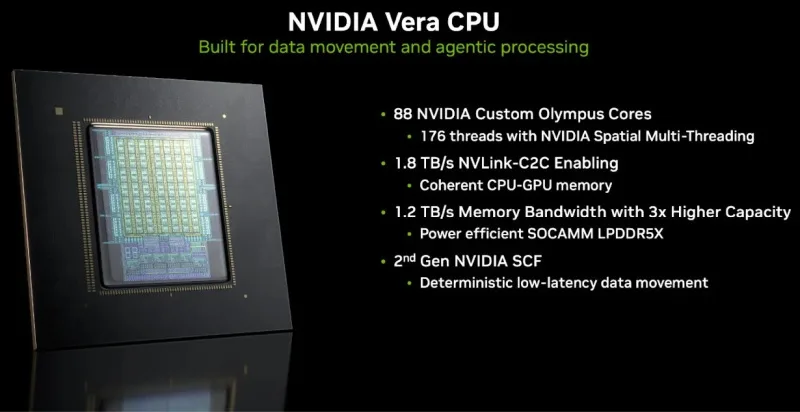
AMD recently highlighted its claimed performance advantage of its Zen 6-based Epyc processors over Nvidia’s Vera CPU, citing results from the SPEC CPU 2026 benchmarks. The chipmaker’s executives expressed satisfaction upon reviewing Nvidia’s published integer performance data for the Vera processor and proceeded to run equivalent tests on a comparable hardware setup featuring Epyc Venice processors built on the Zen 6 architecture.
According to AMD, the Epyc Venice configuration demonstrated throughput that was reportedly 2.2 times greater than that of Nvidia’s Vera, with single-core performance exceeding the rival chip by approximately 20%. These findings aim to establish AMD’s chips as superior in efficiency and processing power for integer-based computational tasks.
However, the validity of this comparative analysis has been met with skepticism by industry observers. Experts have noted that performance benchmarks can be influenced by a variety of factors such as system configuration, software optimizations, and the specific conditions under which tests are conducted. The exact test environments utilized by each company and the consistency in test parameters have not been fully detailed, leaving room for interpretation regarding the comparative figures.
Specifically, the challenge arises in determining whether the workloads and system settings perfectly matched across the two platforms. Discrepancies in compiler settings, firmware versions, memory configurations, and even cooling solutions can impact benchmark outcomes, complicating direct performance comparisons.
Nvidia’s Vera processor—part of the company’s expansion into data center CPUs designed to complement its GPU offerings—serves different architectural priorities, potentially reflecting distinct design goals such as balanced AI and integer processing capabilities. Meanwhile, AMD’s Epyc processors have long been established in the server and data center market, often praised for their high core counts and strong per-core performance.
Benchmark results like SPEC CPU 2026 offer valuable insights, but interpreting such data calls for a nuanced understanding of test conditions and hardware diversity. Both AMD and Nvidia continue to push advancements in CPU technologies tailored for enterprise and AI workloads, where factors beyond raw integer throughput increasingly matter, including workload-specific accelerations and energy efficiency.
While AMD’s confidence in the Zen 6 architecture’s capabilities is evident, the exact landscape of processor leadership remains complex. Independent third-party benchmarking under standardized conditions will provide clearer guidance on relative performance as both companies advance their next-generation hardware.
As the market evolves, customers seeking the best processor solutions for their specific requirements should consider a broad range of metrics and real-world performance scenarios beyond early benchmark claims.
AMD asserts its Zen 6-based Epyc processors outperform Nvidia’s Vera in SPEC CPU 2026 benchmarks, but the comparison has raised concerns.