App Store Sees Surge in New Apps Amid Growth of No-Code Platforms in Early 2026
July 21, 2026
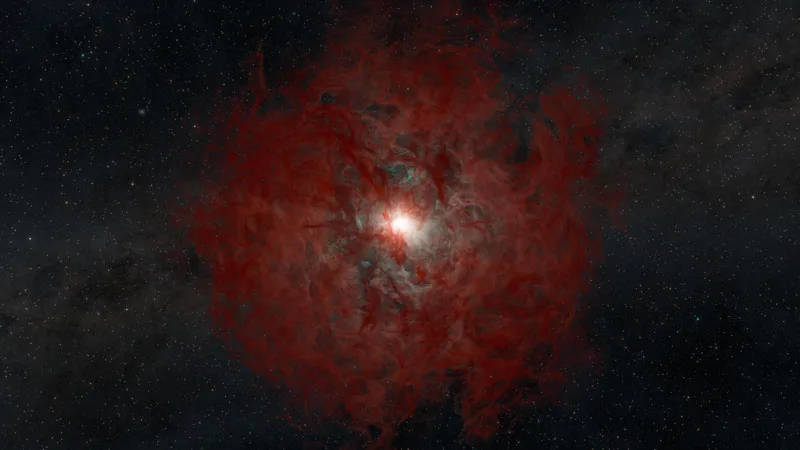
Astronomers have uncovered a rare cosmic event where a black hole formed without the typical bright and violent supernova explosion. This unusual process challenges conventional understanding of black hole births and sheds new light on stellar evolution.
Traditionally, black holes are believed to emerge following the spectacular death of massive stars, marked by dramatic supernova explosions that release immense amounts of energy and light. However, recent investigations reveal that black holes can also form in a much more subdued manner, lacking the expected explosive signatures that usually announce their arrival.
Researchers analyzed archival data from NASA’s now-retired NEOWISE mission, an infrared space observatory renowned for surveying the sky in infrared light. The infrared observations, complemented by data from other telescopes, allowed scientists to trace the history of this rare event with greater clarity. Without the optical fireworks of a supernova, the black hole’s formation remained elusive until comprehensive infrared observations were carefully reviewed.
This discovery highlights an alternative pathway for black hole formation. Instead of undergoing the well-documented, luminous supernova phase, some massive stars may collapse directly into black holes, effectively bypassing the explosive phase. This silent collapse scenario, while theoretically predicted, has lacked conclusive observational evidence until now.
Understanding these quiet black hole births is crucial as it expands knowledge about the diverse endpoints of stellar life cycles. It also impacts measurements of black hole populations in the universe, as silent collapses may contribute to a previously underestimated portion of the black hole census.
Further detailed studies leveraging multi-wavelength data are anticipated to refine the understanding of this phenomenon. The unique ability of infrared observatories like NEOWISE to detect the faint glow of cosmic events obscured in visible light plays a pivotal role in uncovering such cosmic mysteries.
The findings not only deepen insight into how black holes form but also open new avenues for exploring stellar remnants that have so far eluded detection due to their lack of traditional explosive signals. This breakthrough underscores the importance of archival data mining and the continued operation of diverse space observatories for expanding the frontiers of astrophysics.
Scientists have traced a rare case of a black hole forming without the usual explosive supernova, using data from NASA’s NEOWISE and other observatories.