Vivo X300 E Launches Soon with Zeiss Optics and Massive 7200mAh Battery
July 20, 2026
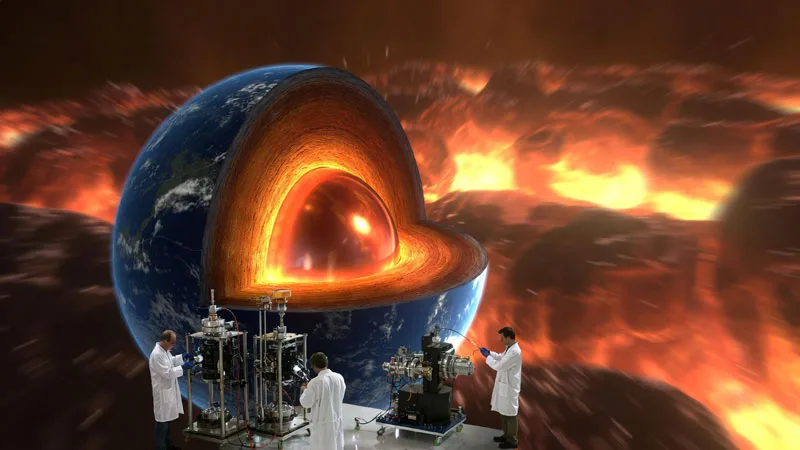
A recent scientific study has provided new experimental evidence suggesting that Earth’s core contains a significant amount of hydrogen, potentially equating to the volume of 45 oceans. This discovery could have considerable implications for our understanding of the planet’s formation and the longstanding theories on the origins of Earth’s water.
For years, geoscientists have debated the composition of the Earth’s core, which is primarily made up of iron. However, the density of the core is lower than that of pure iron alone, implying the presence of lighter elements mixed in. Hydrogen has been regarded as a leading candidate to account for this discrepancy, though direct evidence remained elusive until the recent experimental research.
The new findings support the hypothesis that there is a substantial hydrogen reservoir locked deep within the core. This hydrogen reservoir is estimated to be equivalent in quantity to roughly 45 times the volume of all the Earth’s oceans combined. Such a volume points to the core serving as the planet’s largest hydrogen store, influencing not only its density but potentially its geochemical and geophysical behavior.
The significance of this discovery extends beyond just Earth’s internal composition. It also challenges previously held views on how Earth’s water came to exist on the surface. The conventional cometary hypothesis, which proposes that Earth’s water was delivered primarily via comet impacts during the planet’s early history, now faces questions due to the vast amount of hydrogen found within the core.
If the core holds such an extensive internal hydrogen supply, it suggests alternative or additional mechanisms for water delivery and storage. This internal reservoir could have played a role in water cycling through Earth’s mantle and crust over geological timescales, potentially altering scientific models of Earth’s hydrological evolution.
The study serves as a reminder of Earth’s complex and dynamic interior and highlights the importance of continued research in geochemistry and planetary science to unravel the mysteries of the planet’s deep structure. Although more work is required to fully understand the implications of hydrogen in the core and its impact on Earth’s water history, the findings present a new perspective that may reshape existing theoretical frameworks.
New research reveals the Earth’s core may contain hydrogen equivalent to 45 oceans, casting doubt on the cometary hypothesis for our planet’s water origin.