Memory Chip Makers Face Potential DRAM Oversupply by 2028 Amid Massive Capacity Expansions
July 20, 2026
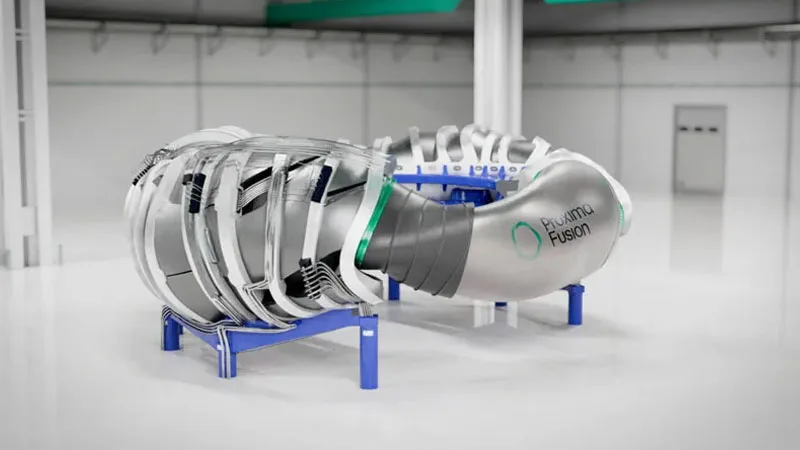
In a major advancement for clean energy in Europe, a Munich-based company, Proxima Fusion, has entered a collaborative agreement with the Bavarian government, energy company RWE, and the Max Planck Institute for Plasma Physics (IPP) to develop the continent’s inaugural fusion power plant.
The partnership centers around constructing a stellarator-type fusion reactor, with plans laid out to eventually establish Europe’s first commercial fusion power station during the 2030s. The initial phase of the project involves building a prototype stellarator named Alpha, designed to become operational at the beginning of the 2030s. This prototype will pave the way for a more advanced stellarator known as Stellaris, which is intended to serve as the foundation for the full-scale power plant.
Fusion energy, long considered a promising source of abundant and clean power, replicates the processes powering the sun by fusing atomic nuclei. Stellarators are one of the key magnetic confinement methods under study internationally to achieve controlled fusion reactions. Unlike tokamaks, stellarators offer the advantage of steady-state operation with reduced plasma instabilities, an attribute that makes them attractive for continuous power generation.
The collaboration brings together scientific expertise, governmental support, and industry experience. The Max Planck Institute for Plasma Physics, a leader in fusion research, contributes its extensive knowledge of plasma behavior and stellarator design. RWE, a major European energy provider, offers insights into integrating fusion power into the existing energy grid and commercial viability. Meanwhile, Proxima Fusion focuses on fusion technology innovation and project execution.
The signing of this memorandum of understanding marks a critical milestone in Europe’s efforts to establish a domestic fusion energy industry. It underscores the increasing role of public-private partnerships in accelerating advanced energy technologies that could contribute significantly to decarbonizing the power sector.
While specific timelines set the operation of the Alpha stellarator at the beginning of the next decade, further technical and regulatory challenges remain before fusion can be scaled up to reliable, grid-ready power generation. Nonetheless, this initiative signals a strong commitment within Germany and Europe to invest in next-generation energy solutions amid growing concerns over energy security and climate change.
As fusion research progresses globally, Germany’s stellarator project reflects a strategic choice to explore alternative fusion configurations alongside internationally dominant tokamak designs. The successful implementation of the Alpha and Stellaris stellarators could position Europe as a leader in fusion energy innovation, potentially transforming energy landscapes for decades to come.
A German consortium will develop a stellarator fusion reactor, aiming to launch Europe’s first fusion power plant in the 2030s.