Vivo X300 E Launches Soon with Zeiss Optics and Massive 7200mAh Battery
July 20, 2026
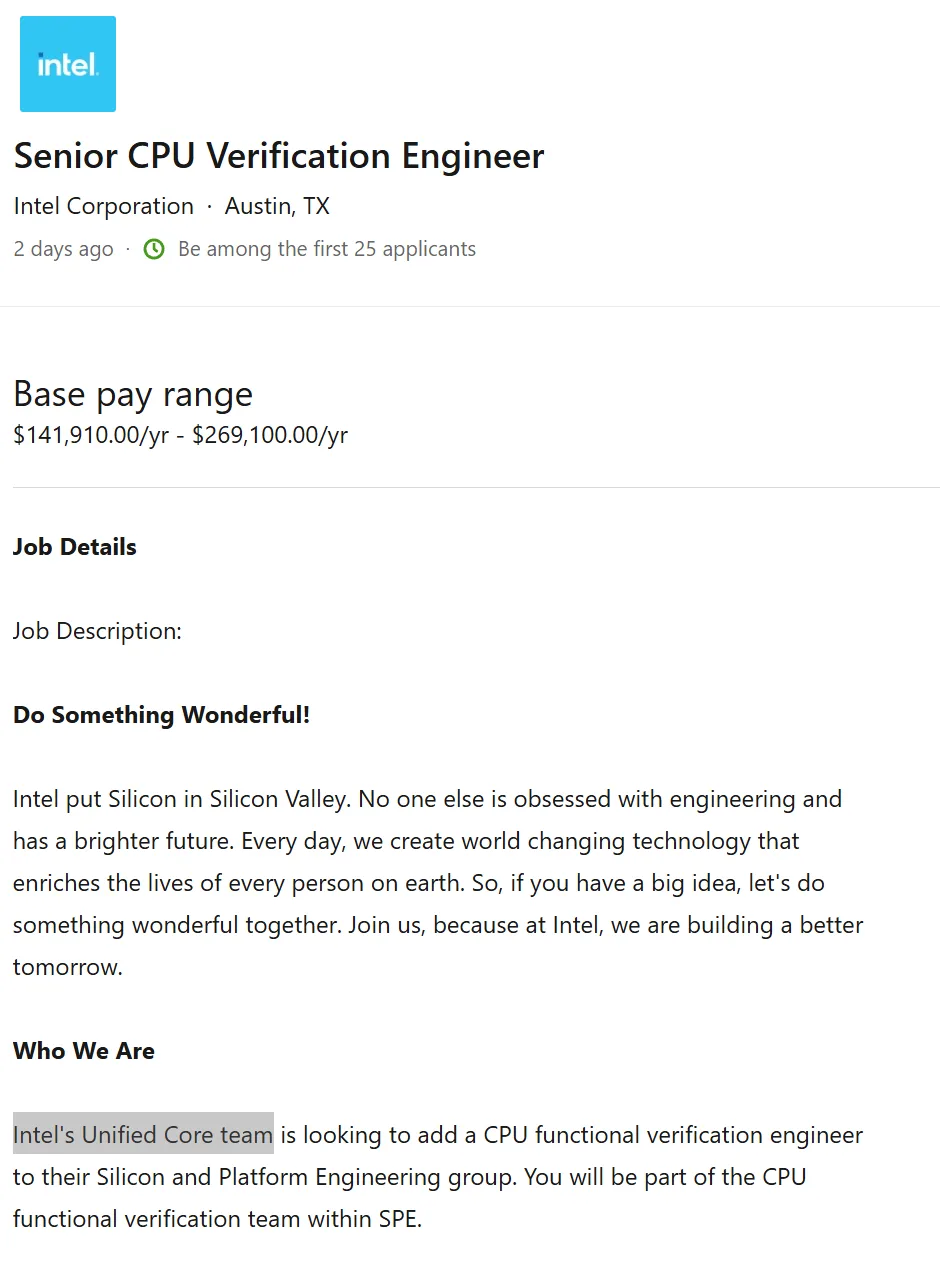
Intel appears to be reevaluating its current hybrid CPU core strategy, which relies on a combination of high-performance and energy-efficient cores. Recent job postings suggest the company is assembling a development team focused on creating a unified core architecture that could replace the distinct core types presently used in its processors.
Since the release of its Alder Lake architecture, Intel has utilized a hybrid approach combining Performance-cores (P-cores) and Efficient-cores (E-cores) to balance computational power and energy consumption. This model has allowed the company to offer processors able to optimize workloads dynamically. However, information gathered from Intel’s recruitment efforts points to a future direction involving a single core architecture, potentially simplifying CPU design and operations.
The transition to a unified core structure is not expected to happen immediately. Industry insiders speculate that the evolution from the current heterogeneous mix to a monolithic design could take several years, given the complexities in engineering, software ecosystem integration, and performance trade-offs involved.
Intel’s search for a lead engineer dedicated to unified core development underscores the seriousness of this strategic consideration. Such a role would spearhead the creation of future CPU cores that no longer distinguish between performance and energy efficiency at the architectural level, possibly marking a significant shift in Intel’s processor roadmaps.
While specific architectural approaches and technical details have yet to be disclosed, the move would represent a notable departure from the hybrid models that have been increasingly prevalent in recent CPU generations from Intel and its competitors alike.
Industry experts remain attentive to how Intel plans to reconcile the benefits of hybrid architectures—such as workload specialization and power savings—with the potential simplification and improved compatibility of unified cores. The outcome of this development effort could influence not only Intel’s product line but also broader trends in CPU design and performance optimization.
For now, Intel’s current lineup continues to utilize the distinct P-core and E-core configuration, but the groundwork being laid hints at architectural innovations that could reshape processor design approaches in the near future.
Intel is reportedly considering moving away from separate performance and efficiency cores toward a unified core architecture, with a transition spanning several years.