
Memory Chip Makers Face Potential DRAM Oversupply by 2028 Amid Massive Capacity Expansions
July 20, 2026
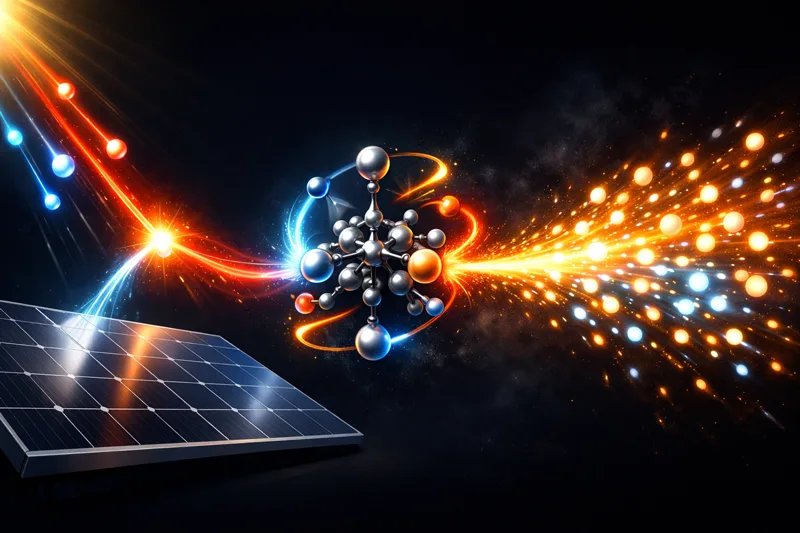
In a breakthrough that challenges conventional understanding of solar energy conversion, researchers in Japan have developed a solar panel that demonstrates quantum efficiency exceeding 130%. This achievement redefines the theoretical boundaries traditionally accepted in photovoltaic technology.
According to classical physics principles, the efficiency of solar cells is fundamentally capped because of inherent energy losses and thermodynamic constraints. For a standard p-n junction solar cell, the maximum achievable efficiency—known as the Shockley-Queisser limit—is approximately 33%. This theoretical ceiling arises due to various loss mechanisms such as photon energy not absorbed, recombination of charge carriers, and heat generation.
While it remains impossible for any energy conversion device to output more energy than it receives—a basic law of physics—the concept of quantum efficiency involves the number of charge carriers generated per incoming photon. Conventional cells typically have quantum efficiencies at or below 100%, meaning one electron is produced per photon absorbed.
The new development from the Japanese research team shows that quantum efficiency can substantially exceed unity, reaching about 130%. This indicates that for each photon of sunlight, more than one electron is generated within the panel, an effect that can dramatically improve power conversion efficiency.
This advancement leverages complex physical phenomena within the solar spectrum and photovoltaic materials. By exploiting mechanisms beyond those accounted for in classical efficiency models, such as multiple exciton generation or up-/down-conversion processes, the researchers have managed to overcome previously assumed theoretical limits.
Such innovation highlights the evolving understanding of solar energy physics and opens the door for next-generation solar panels with markedly enhanced performance. The ability to harvest additional electrical current per photon can contribute to more effective use of sunlight, reducing costs and improving the feasibility of solar energy on a wider scale.
While the research offers promising advancements, details regarding the commercial scalability, material costs, and durability of these high-quantum-efficiency panels were not disclosed. Further development and testing are expected to assess their practical viability for integration into existing solar infrastructure.
The breakthrough marks a significant milestone in the quest to push photovoltaic efficiencies closer to, and even beyond, traditional theoretical boundaries, signaling a new chapter in solar power technology innovation.
Japanese scientists have created a solar panel achieving quantum efficiency beyond 130%, challenging traditional photovoltaic efficiency limits.