Memory Chip Makers Face Potential DRAM Oversupply by 2028 Amid Massive Capacity Expansions
July 20, 2026
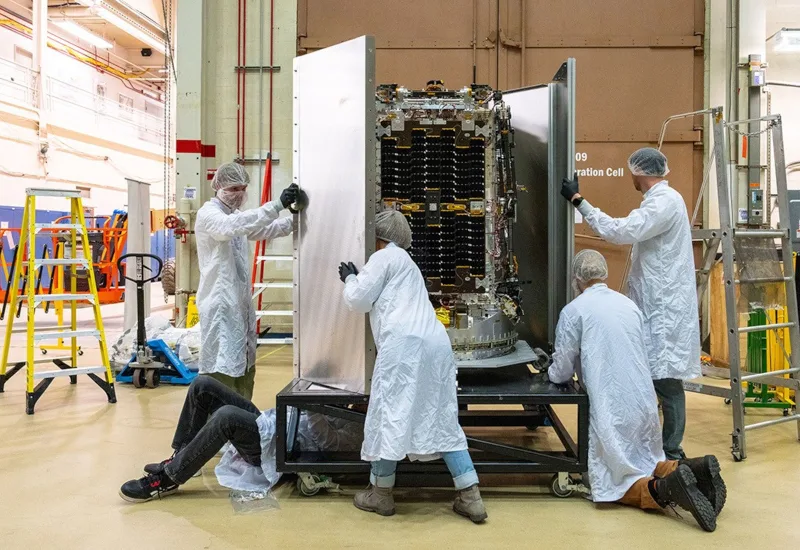
The LINK service satellite, designed to capture and tow satellites in low Earth orbit, recently completed a series of tests at NASA’s Goddard Space Flight Center. This accomplishment represents a significant step forward in an ongoing mission to preserve the Neil Gehrels Swift Observatory, which is currently at risk of reentering and burning up in Earth’s atmosphere.
Operated by NASA, the Neil Gehrels Swift Observatory has played a crucial role in monitoring gamma-ray bursts and enabling rapid follow-up observations across multiple wavelengths. However, its orbit has gradually decayed, putting the spacecraft on a trajectory toward atmospheric reentry. To address this, engineers developed LINK, a specialized service satellite intended to dock with and maneuver satellites no longer capable of maintaining their orbits independently.
LINK’s capability to capture and relocate satellites could mark a transformative advancement in satellite servicing technology, potentially extending the operational lifespans of aging spacecraft. The recent tests conducted at the Goddard Space Flight Center have been pivotal in validating LINK’s systems and readiness for its upcoming mission.
The plan involves integrating LINK aboard Northrop Grumman’s Pegasus rocket, a launch vehicle known for its air-launched deployment from a carrier aircraft. The installation is targeted for early June 2026, with the launch window anticipated in the latter half of the month. This timeline positions the mission on track to intercept and stabilize the Swift Observatory ahead of its uncontrolled descent.
This mission highlights growing interest within the space sector to develop in-orbit servicing and debris mitigation solutions, addressing the growing population of satellites and space debris in Earth’s vicinity. Success with LINK could pave the way for more routine maintenance, repair, and repositioning missions in the future, contributing to the sustainability of space operations.
While specific technical details regarding LINK’s systems and the rescue procedure have not been publicly disclosed, the completion of these tests at a premier NASA facility reinforces confidence in the satellite’s capabilities. The collaboration between government space agencies and aerospace companies like Northrop Grumman demonstrates the increasing integration needed for complex orbital servicing missions.
As the launch approaches, the space community will be closely monitoring the progress of LINK’s deployment and its efforts to preserve one of NASA’s key astronomical observatories. The outcome of this operation could establish a blueprint for future missions aiming to extend the lifespans of valuable assets in orbit.
The LINK satellite passed tests at Goddard, advancing plans to save the Swift Observatory from deorbiting with a Pegasus launch in mid-2026.