
Nvidia GPUs Can Report Individual GDDR6 and GDDR6X Memory Chip Temperatures, Enthusiasts Discover
July 19, 2026
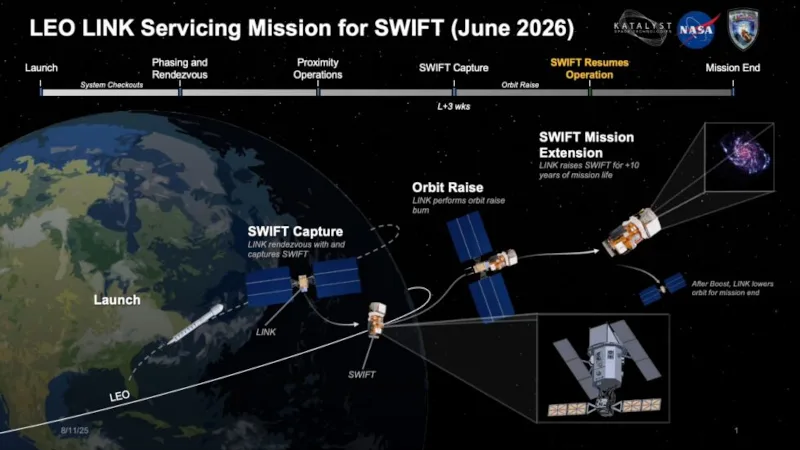
NASA has commissioned a private aerospace company to undertake a critical operation aimed at preserving the Neil Gehrels Swift Observatory, a valuable space-based observatory whose orbit is rapidly decaying due to atmospheric drag. This mission represents a landmark effort to extend the operational life of a government satellite through commercial orbital servicing.
The Swift Observatory, valued at approximately $500 million, has been steadily losing altitude and is at risk of reentering Earth’s atmosphere later this year if no action is taken. In response, NASA awarded a $30 million contract to Katalyst Space Technologies. Under this agreement, Katalyst is tasked with launching a servicing spacecraft called Link by June 1.
Once deployed, the Link vehicle will rendezvous with the aging Swift satellite, capture it, and execute an orbital boost maneuver designed to raise its altitude and stabilize its trajectory. This intervention aims to extend Swift’s operational lifespan and avoid the loss of a critical asset in astronomy and space science.
The mission is pioneering in several respects, as the Swift Observatory was not originally designed to support servicing or in-orbit refueling. Successfully capturing and boosting the satellite will demonstrate the potential for commercial spacecraft to provide life extension services to government assets that are not serviceable by traditional means.
This operation will test the viability of commercial orbital maintenance, which could have significant implications for the future management of valuable satellites. Extending satellite lifespans through in-orbit servicing could reduce the need for costly replacements and mitigate space debris accumulation.
The outcome of this mission will provide valuable insights into how commercial space enterprises can collaborate with government space agencies to maintain the longevity of aging satellites. As atmospheric drag continues to threaten increasingly lower orbit satellites, such innovation may become indispensable for sustainable space operations.
NASA’s decision to engage a commercial firm in this mission marks a growing trend toward public-private partnerships in space exploration and satellite management. The success or failure of this pioneering endeavor will likely influence future policies and strategies around satellite servicing in orbit.
NASA contracts Katalyst Space to launch a servicing mission aimed at boosting Swift Observatory’s orbit before it deorbits later this year.