
Memory Chip Makers Face Potential DRAM Oversupply by 2028 Amid Massive Capacity Expansions
July 20, 2026
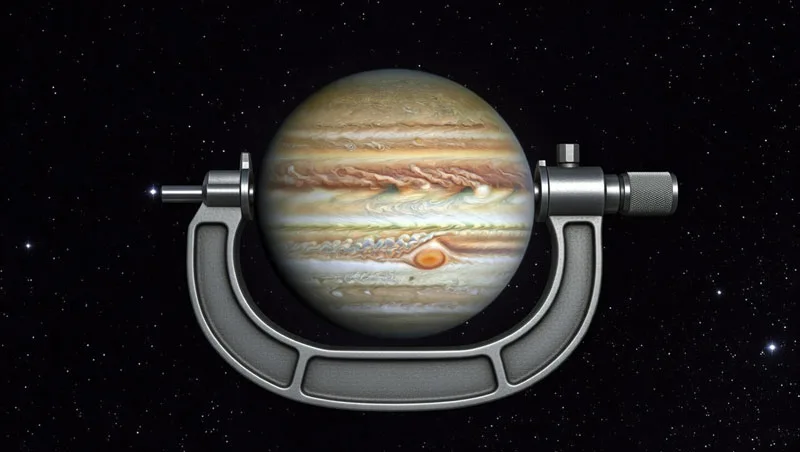
NASA’s Juno spacecraft, which has been orbiting Jupiter for an extended mission duration, has delivered revised measurements of the gas giant’s size. This updated data confirms that Jupiter is slightly smaller than previously estimated, a refinement that carries implications for understanding the planet’s internal structure and atmospheric dynamics.
Jupiter, the largest planet in the Solar System, has long been a subject of study due to its complex composition and influential role in planetary science. The Juno probe’s extended observations have allowed scientists to fine-tune fundamental parameters such as the planet’s radius and volume. Although the decrease in size is minimal, this adjustment is significant enough to affect theoretical models related to the planet’s core and atmospheric behavior.
Accurate measurements are critical for advancing scientific knowledge about Jupiter’s gravitational field, magnetic environment, and the processes driving its weather systems. The refined dimensions contribute to a better understanding of these phenomena and help in constraining models of giant planet formation.
Juno continues to provide valuable insights as it collects data, leveraging instruments designed to probe below Jupiter’s thick cloud layers. The mission’s findings are expected to enhance the broader field of planetary sciences and support future exploration efforts within our Solar System.
NASA’s Juno mission provides updated, slightly smaller measurements of Jupiter, enhancing models of its core and atmosphere.