TSMC Plans $265 Billion Investment to Expand U.S. Chip Manufacturing Amid Rising Competition
July 20, 2026
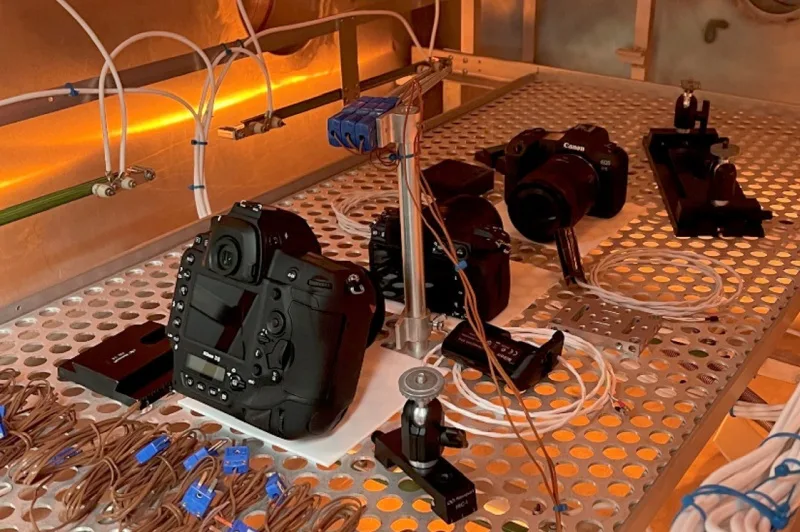
NASA has conducted a series of tests on commercially available cameras from Canon and Nikon to determine their ability to operate in the extreme environments encountered during space missions. The agency’s recent report outlines the initial results from testing unmodified standard photography equipment under conditions designed to simulate the challenges of outer space.
In 2022, NASA undertook experimental evaluations of popular camera models including the Canon EOS R5, Nikon D6, and Nikon Z7II. The goal was to assess each device’s performance and resilience without custom modifications, reflecting a trend toward leveraging consumer-grade technology for space applications to potentially reduce costs and development time.
The tests involved exposing these cameras to environmental stressors that closely mimic the conditions encountered beyond Earth’s atmosphere. This includes factors such as extreme temperature fluctuations, vacuum-like pressures, radiation exposure, and mechanical vibrations typically experienced during launch and operation in orbit.
The findings from this rigorous evaluation process highlighted varying degrees of success among the cameras. While some units maintained operational integrity, others failed to meet the stringent requirements posed by the space-like testing parameters. The report underscored that not all commercial cameras are equally capable of enduring the demanding environment, raising concerns about their reliability during critical mission phases.
NASA’s interest in assessing off-the-shelf photographic equipment reflects a broader initiative to integrate commercially available technologies into space missions. This approach can streamline mission preparation and potentially expand the range of equipment suitable for capturing high-quality imagery in space exploration efforts.
However, this testing phase illustrates the necessity of thorough validation for any hardware intended for use in space. The performance and durability of devices originally designed for terrestrial use can vary significantly when subjected to the harsh conditions beyond Earth, necessitating careful selection and possibly modifications or protective measures before deployment.
While specific details regarding which cameras succeeded or failed in the trials were not fully disclosed, NASA’s publication of these preliminary results provides valuable insights for the space technology community. The data inform future decisions on camera procurement and design adjustments needed to ensure optimal functionality in off-world environments.
As missions to the Moon, Mars, and beyond continue to advance, reliable imaging devices remain crucial for documentation, scientific observation, and operational monitoring. NASA’s ongoing evaluation efforts play a pivotal role in identifying suitable technology solutions that can withstand the rigorous demands of space travel while capturing vivid and precise visuals for mission success.
NASA evaluated unmodified Canon and Nikon cameras under simulated space conditions, revealing durability challenges for some models.