Tasmania Begins Construction of Ultra-Secure Climate Archive Bunker
June 19, 2026
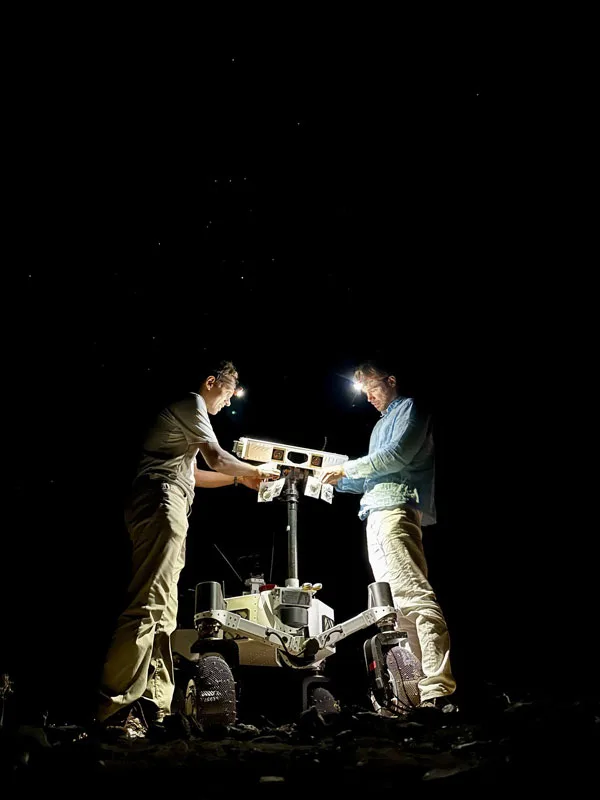
NASA’s Jet Propulsion Laboratory (JPL) recently conducted field trials of a new robotic rover named ERNEST—short for Exploration Rover for Navigating Extreme Sloped Terrain—in the Colorado Desert. Designed as an experimental platform, ERNEST represents a significant step forward in the development of mobility systems that could enhance future lunar and Martian rovers.
Measuring approximately 1.2 meters in length and equipped with four wheels, ERNEST was put through a series of challenging maneuvers to evaluate its ability to traverse difficult landscapes. The tests emphasized the rover’s capacity to climb over rocks and navigate steep, rugged environments that typically impede conventional rover designs.
One of the key highlights from these trials was ERNEST’s capability to move sideways in a crab-walking manner, a maneuver that increases its flexibility and stability on uneven ground. This technique enables the rover to approach obstacles at angles that are otherwise difficult to negotiate, broadening the range of navigable terrain substantially.
According to reports, ERNEST demonstrated a remarkable increase in performance over existing rover platforms, particularly in terms of speed when advancing across complex surfaces. On certain difficult sections, ERNEST’s velocity was nearly ten times greater than that of previous prototypes or operational rovers, suggesting a major improvement in traversal efficiency and mission productivity potential.
The technology embedded in ERNEST is intended to serve as a testbed for new mobility solutions that may be integrated into future robotic explorers. Enhanced climbing ability and versatile locomotion are crucial for extending the operational range and lifespan of vehicles tasked with planetary exploration, especially on bodies like the Moon and Mars that feature unpredictable and challenging terrains.
While detailed specifications and deployment timelines for ERNEST-enabled missions have not been disclosed, the successful desert tests mark a promising advancement in NASA’s ongoing efforts to improve robotic exploration systems. By simulating harsh extraterrestrial conditions here on Earth, engineers are gathering essential data to help inform the design of next-generation rovers capable of reaching and studying previously inaccessible areas.
ERNEST’s development exemplifies NASA and JPL’s commitment to innovating robotic technologies that can expand humanity’s reach in space exploration. As rover platforms evolve, capabilities such as rock climbing and crab-walking could become standard features, enhancing scientific return and operational safety for missions venturing into the solar system’s most extreme environments.
NASA’s JPL engineers tested the ERNEST rover in Colorado desert, showcasing its advanced rock-climbing and crab-walking abilities on rugged terrain.