US Considers Restrictions on Chinese Open-Weight AI Models Including Kimi K3
July 21, 2026
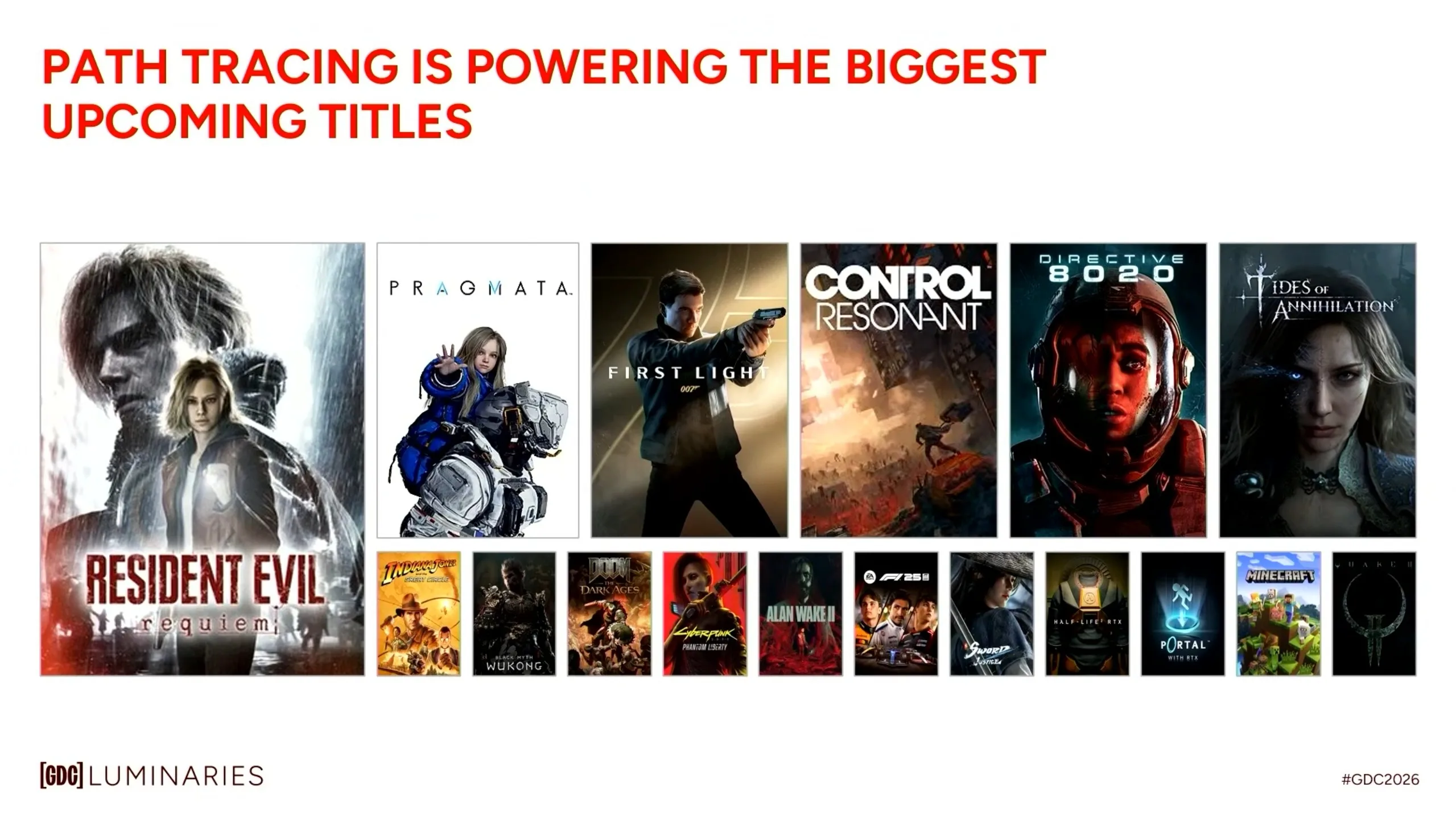
Nvidia has outlined ambitious goals to revolutionize graphics rendering in future GPUs by drastically accelerating ray tracing and path tracing technologies. The announcement came during the Game Developers Conference (GDC) 2026, where the company highlighted its ongoing commitment to advancing visual fidelity in gaming and professional graphics applications.
Since launching the Turing architecture and the RTX 20 series, Nvidia has been a leader in delivering real-time ray tracing capabilities. The RTX lineup has consistently outperformed rivals from Intel and AMD by leveraging innovations like artificial intelligence and neural rendering techniques to boost visual detail while maintaining solid performance.
Building on these technological foundations, Nvidia revealed plans to achieve unprecedented speedups in ray tracing and path tracing, aiming for an improvement by a factor of one million. This would represent a monumental leap in rendering efficiency, opening new possibilities for lifelike visuals and immersive gaming experiences.
The company’s efforts focus on combining hardware advancements with AI-driven rendering approaches to reduce the computational burden traditionally associated with realistic lighting and shadow effects. Neural rendering has played a critical role so far, enabling complex scenes to be rendered with greater accuracy without the extensive performance costs that typically limit ray tracing adoption.
Nvidia’s push comes against the backdrop of intensifying GPU competition. While Intel and AMD have made strides in integrating ray tracing capabilities into their graphics solutions, Nvidia’s leadership in this space remains clear. The promise of significantly accelerated ray tracing and path tracing positions Nvidia to maintain a critical edge in both gaming and professional graphics markets.
Details regarding the timeline, specific architectural changes, or expected product launches linked to these transformative enhancements have not been disclosed. However, the company’s message at GDC 2026 underscores a clear trajectory toward more powerful and efficient GPU designs that deeply integrate AI technologies for improved rendering performance.
As ray tracing continues to mature, the technology is increasingly recognized as a vital component for pushing graphical realism forward. Nvidia’s forecasted advancements suggest that upcoming GPUs will enable developers and gamers alike to experience visual effects that are not only more accurate but also more computationally feasible in real time.
This vision aligns with the broader industry trend where hardware and software innovations coalesce to drive new standards of performance and visual quality. Nvidia’s anticipated breakthroughs in ray tracing acceleration could fundamentally reshape how graphics are rendered, influencing game development, digital content creation, and various sectors that rely on advanced visualization.
In summary, Nvidia’s announcement at GDC 2026 sets a bold future for GPU technology with a focus on dramatically enhanced ray tracing and path tracing capabilities. The aim to achieve a million-fold speed increase signals a new era where AI-powered rendering might redefine the boundaries of computer graphics.
Nvidia announces plans to dramatically enhance ray tracing and path tracing speeds in upcoming GPUs, aiming for a million-fold improvement.