
Popular PC Components in Russia Highlight Nvidia RTX 50 Series and 1TB NVMe SSDs
July 21, 2026
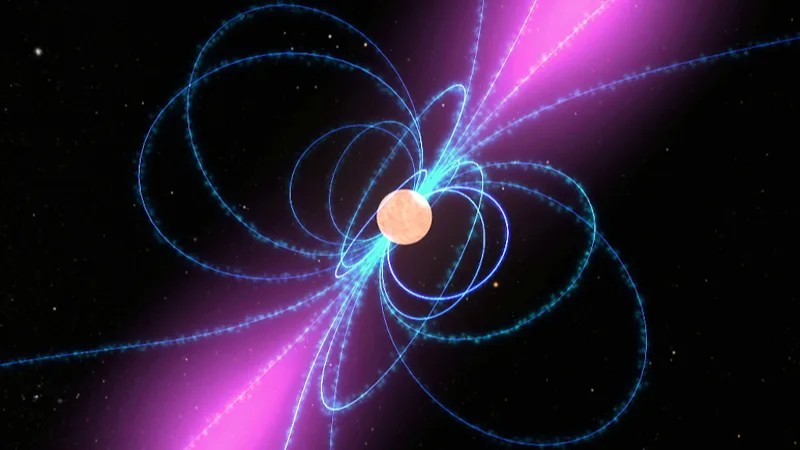
Astronomers have uncovered new insights about the radio emission mechanisms of millisecond pulsars, a type of rapidly spinning neutron star formed from the remnants of massive stars. Contrary to long-standing beliefs that these pulsars emit radio waves exclusively from their magnetic poles, recent analysis suggests a more intricate emission geometry.
Millisecond pulsars are renowned for their exceptionally fast rotation rates, often completing hundreds of rotations per second. Traditionally, their radio emissions have been understood to originate mainly from narrow regions near the magnetic poles of the star, producing periodic signals detectable by radio telescopes on Earth.
However, a comprehensive study examining radio observations of nearly 200 millisecond pulsars has revealed that approximately one-third exhibit radio emissions stemming from two or more separate regions within their magnetospheres. This contrasts sharply with slower-spinning neutron stars, where only about 3% display such multi-zone emission patterns.
This finding implies that the magnetic and plasma environments of millisecond pulsars are more complex than previously thought, with radio waves potentially generated near the edges of their magnetospheres rather than limited to the magnetic poles alone.
The magnetosphere surrounding a pulsar is a highly magnetized region filled with charged particles that interact with the star’s magnetic field. The new observations suggest that the structure of this magnetosphere, especially in millisecond pulsars, can support multiple radio-emitting areas. This has significant implications for the theoretical models used to describe pulsar emission mechanisms and magnetic field configurations.
The discovery invites further research to understand the physical processes responsible for these multiple emission zones. It also raises questions about how these complex emission geometries affect the timing and intensity of the pulsar signals, which are critical for studies ranging from tests of general relativity to the search for gravitational waves using pulsar timing arrays.
While the details of the mechanisms producing radio waves at the edges of magnetospheres remain to be fully understood, this work marks an important step in refining the picture of how neutron stars operate and interact with their surrounding environments.
In summary, the findings present a notable shift in the understanding of millisecond pulsars, emphasizing the need to account for multi-zone radio emission regions when analyzing these cosmic timekeepers.
Astronomers find that a third of millisecond pulsars emit radio waves from multiple magnetospheric regions, challenging decades-old assumptions.