Memory Chip Makers Face Potential DRAM Oversupply by 2028 Amid Massive Capacity Expansions
July 20, 2026
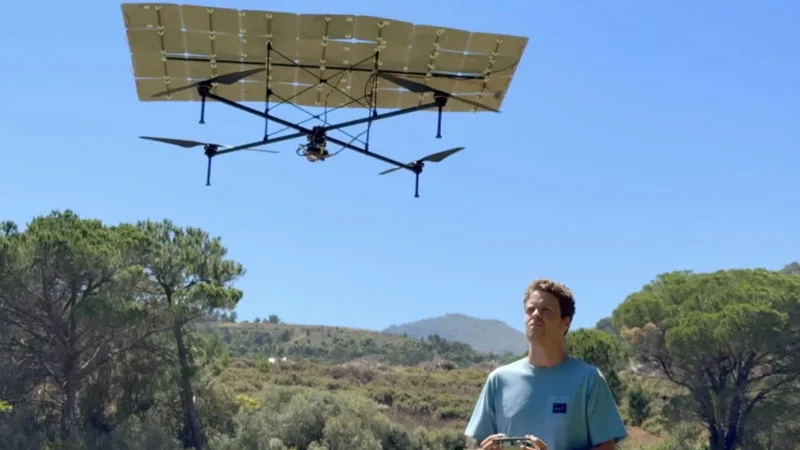
Engineering innovation in the field of unmanned aerial vehicles (UAVs) has taken a notable leap forward, thanks to the efforts of a South African team. Mike and Luke Bell, a father and son duo, have pivoted their focus from crafting high-speed homemade quadcopters to developing drones capable of extended flight durations. Their latest prototype is a solar-powered quadcopter that has achieved a remarkable feat by remaining airborne for a continuous five hours.
The Bells’ work represents a significant exploration into the use of solar energy to overcome one of the biggest challenges for drone technology: limited flight time. Traditionally, commercial and DIY quadcopters rely heavily on battery capacity, which caps their operational periods to relatively short intervals — often measured in minutes. By integrating solar panels to harness energy from sunlight, this new prototype can sustain flight for several hours without the need for battery replacement or ground-based recharging.
This extended flight duration demonstrates the practical potential of renewable energy in drone design, particularly for applications requiring long missions without landing. The use of solar power in UAVs can be especially advantageous for fields such as environmental monitoring, surveillance, and agricultural mapping, where drones need to cover broad areas and operate independently for extended times.
Mike and Luke Bell’s background includes building some of the fastest homemade quadcopters, which earned them considerable recognition and may one day feature in the Guinness World Records. Transitioning to endurance-focused models reflects a strategic shift toward addressing a different set of technical challenges, including power efficiency, lightweight materials, and optimal energy harvesting.
While specific technical details, such as the size of the solar panels, battery specifications, or drone dimensions, were not disclosed, the achievement of a five-hour sustained flight stands as a proof of concept that solar-assisted drone flights can markedly extend airborne timeframes. This accomplishment highlights the evolving capabilities of DIY drone development driven by innovative use of existing technologies.
Despite the drone’s impressive in-air duration, the operating team noted human limitations played a role in the overall test length. The endurance of the pilot or operator remains an important factor in managing drone flights, especially for manual control scenarios. This underscores an ongoing balance between technical advancements in drone hardware and the practicalities of human operator involvement.
Looking ahead, the Bells’ prototype paves the way for further exploration into solar-powered UAVs, potentially inspiring advances in commercial and custom-built drones. Solar energy integration could become a key component for next-generation drones, enabling longer missions with reduced environmental impact.
A South African father-son team built a solar-powered quadcopter that stayed airborne for five hours, marking a significant step in drone endurance.