Advancements in CFET Technology Promise Faster, Smaller, and More Reliable Semiconductor Transistors
July 21, 2026
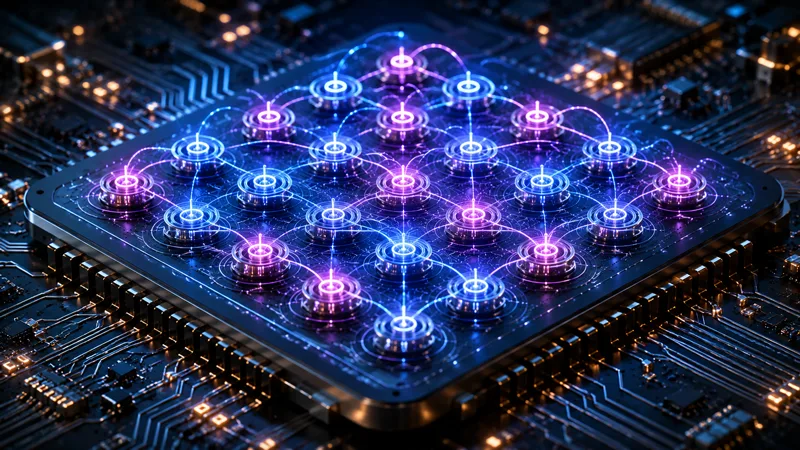
Researchers at the Korea Advanced Institute of Science and Technology (KAIST) have developed an innovative computing architecture utilizing silicon oscillators capable of tackling complex combinatorial problems with significantly improved speed compared to conventional semiconductor-based computers.
This breakthrough marks what scientists describe as a “third era” in transistor technology, where the foundational elements of computing shift from traditional transistor switching to harnessing the dynamics of silicon-based oscillators—or generators—to achieve computational tasks.
The novel system leverages the physical properties of these oscillators to process information more efficiently. Unlike traditional transistor circuits that rely on binary states and sequential logic operations, the silicon oscillator approach allows for parallel and highly dynamic computation, which is especially advantageous for solving complex combinatorial challenges.
Combinatorial problems, common in optimization, cryptography, and artificial intelligence, require examining numerous possible permutations to find optimal solutions. The new silicon oscillator-based processors promise speed improvements by factors ranging across millions and potentially billions over current classical semiconductor processors, signaling a significant leap in computational capacity.
This advancement could have far-reaching implications across various technology sectors where complex problem-solving is critical. From AI models requiring intense data crunching to cybersecurity systems and logistical planning algorithms, the improved processing speed and efficiency could transform the capabilities of future hardware.
While specific details regarding the implementation and commercialization of this technology have yet to be disclosed, the development represents a substantial step towards rethinking foundational computing hardware. It may open pathways toward processors that operate on fundamentally different principles from those dominating the semiconductor industry for decades.
The research underscores ongoing global efforts to push beyond the limits of Moore’s Law and traditional transistor scaling by introducing alternative methods to improve computational performance. Silicon oscillators could become a new paradigm in how processing power is architected, accelerating progress in fields heavily dependent on advanced computation.
Further studies and development will determine how this technology integrates with existing systems and scales for widespread use. Nonetheless, this announcement from KAIST highlights a promising direction in the evolution of computer hardware, potentially triggering a transformative shift in how complex computational tasks are handled.
Scientists at KAIST introduced a new silicon oscillator computing system that promises to solve complex problems far faster than traditional chips.