App Store Sees Surge in New Apps Amid Growth of No-Code Platforms in Early 2026
July 21, 2026
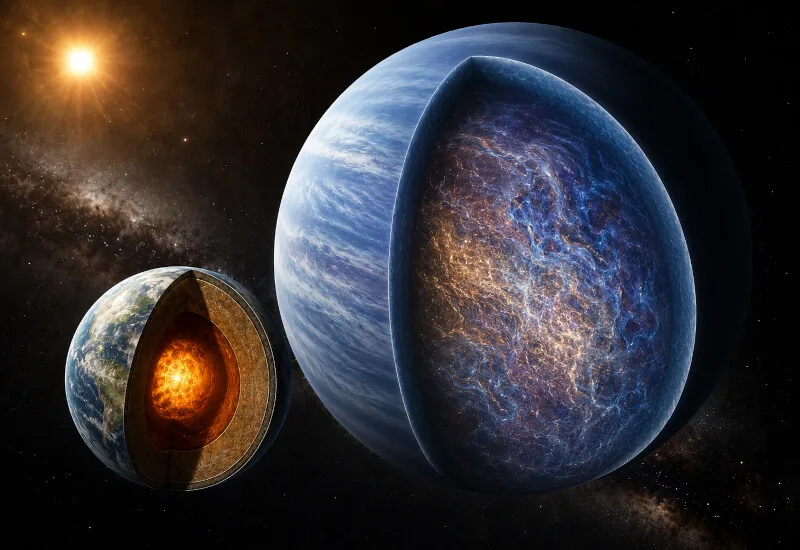
Recent findings published in The Astrophysical Journal and posted on the arXiv preprint server propose a novel model for the internal structure of sub-Neptune exoplanets, a prevalent class of planets found throughout the Milky Way. These celestial bodies, which are larger than Earth yet smaller than Neptune, may not have the typical stratified cores long assumed by planetary scientists.
The study challenges the traditional understanding that planets possess distinct, layered interiors made up of a dense core surrounded by a mantle. Instead, researchers suggest that when these sub-Neptune planets accumulate sufficient hydrogen during formation, their interiors become a homogenous, searing mixture. In this state, iron, hot rock, and hydrogen are thoroughly blended, resulting in no clear boundary separating a core from the mantle.
This new theoretical framework helps explain a range of observed characteristics in exoplanets that had previously puzzled scientists. Conventional models could not adequately elucidate certain anomalies in the density, composition, and atmospheric properties of sub-Neptune planets detected by space telescopes and other instruments.
The research implies that sub-Neptune planets may be fundamentally different from terrestrial planets like Earth or gas giants such as Neptune. While Earth has a well-defined iron core, and Neptune has layers of gas enveloping a rocky mantle and a distinct core, sub-Neptunes could exhibit a seamlessly mixed interior where the distinction between core and mantle breaks down.
The significance of this research extends to understanding planetary formation and evolution processes across the galaxy. Given that sub-Neptunes are among the most common types of planets orbiting other stars, insights into their composition and structure are crucial for broadening our knowledge of planetary systems and their diversity.
These findings underline the importance of developing advanced, nuanced planetary models that account for varied formation histories and material interactions. The study’s authors encourage continued observational efforts combined with theoretical work to verify and refine this new perspective on planet interiors.
New research suggests most sub-Neptune exoplanets in our galaxy may have no distinct cores, challenging previous planetary structure models.