SK hynix CEO Predicts Memory Chip Shortage Will Peak in 2027 and Persist Beyond 2030
July 11, 2026
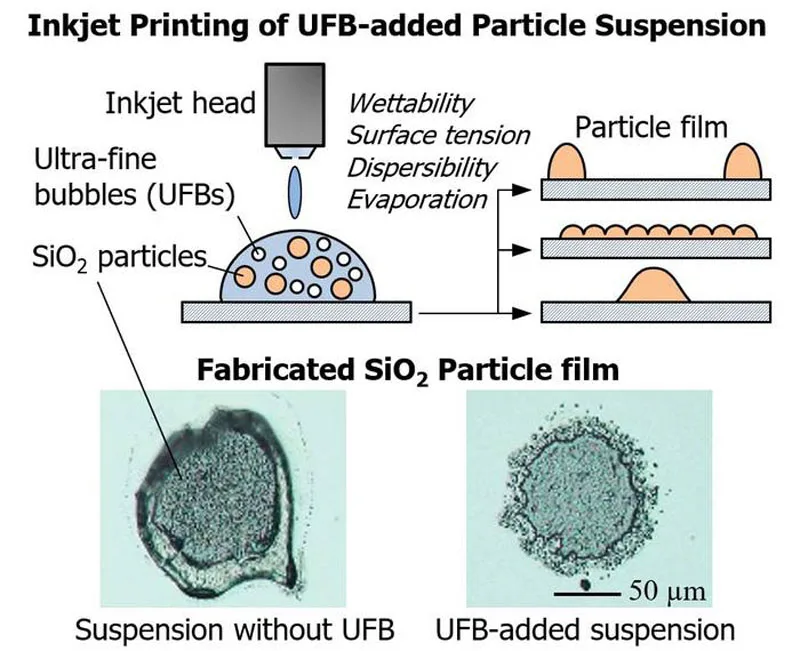
Researchers at Tokyo Metropolitan University have introduced a novel technique aimed at significantly enhancing the quality of inkjet printing for electronic circuits. This advancement seeks to refine printing precision and output without increasing production costs or causing environmental harm.
The research team drew inspiration from an everyday phenomenon: carbonated drinks. These beverages are characterized by their evenly distributed gas bubbles and the fact that once spilled and dried, they do not leave noticeable residues. Applying this natural principle, the scientists devised a method to manage the distribution of materials used in electronic circuit printing, thus preventing common defects associated with inkjet deposition.
Inkjet printing plays an essential role in producing flexible and printable electronics, where the precision of conductive inks impacts both performance and reliability. Traditional methods sometimes struggle with uneven spreading or residue buildup, which compromises circuit integrity. By mimicking the way carbonation bubbles ensure even saturation and residue-free drying, the researchers achieved a more uniform deposition of conductive material.
This innovative approach enhances the performance and appearance of printed circuits while maintaining a sustainable process. Notably, it does so without requiring additional expense or environmentally harmful substances, addressing two critical concerns in large-scale electronics manufacturing.
Though specific details about the materials or exact procedural changes were not disclosed, the breakthrough highlights the potential of interdisciplinary inspiration in technological development. The intersection of material science and observations from everyday liquids opens avenues for improved manufacturing techniques in electronics.
The advancement represents a promising step toward more efficient and eco-friendly production of electronic components, supporting the growing demand for flexible devices and printed electronics. As the fields of wearable technology and IoT devices expand, such improvements in printing quality could play a pivotal role in next-generation electronics manufacturing.
Further studies and development are expected to refine this printing technique and potentially integrate it into commercial manufacturing processes, potentially setting new industry standards for sustainable and cost-effective electronics fabrication.
Scientists at Tokyo Metropolitan University developed a method to improve inkjet-printed electronic circuits, drawing inspiration from carbonated beverages.