Thermalright Introduces Royal Pretor 130 Vision Cooler with Integrated 3.95-Inch Color Display
July 21, 2026
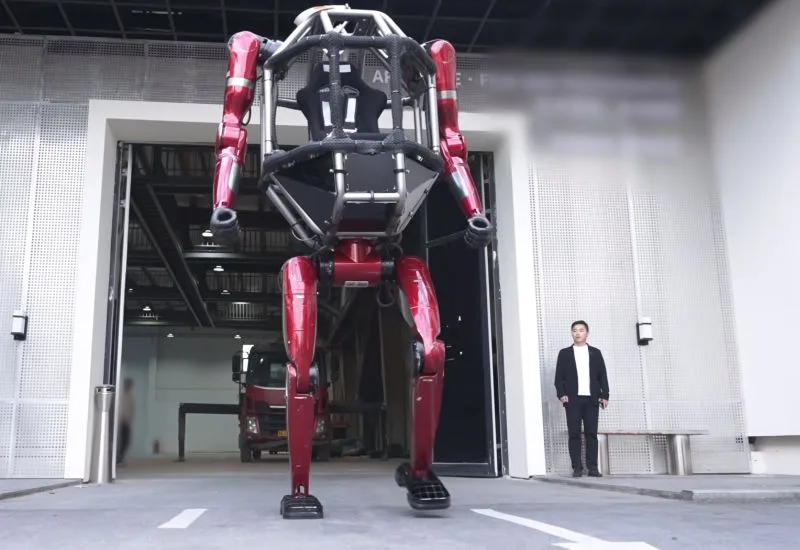
Chinese robotics manufacturer Unitree has introduced an innovative walking robot that stands out due to its capacity to carry a human driver inside an onboard cabin. Weighing approximately 500 kilograms, the machine pushes the boundaries between robotics, engineering, and human interaction.
The newly revealed walking robot from Unitree marks a significant step in robotic mobility, merging bipedal motion with human occupancy. Unlike typical quadruped robots developed by the company, this model incorporates a cockpit area designed to accommodate an individual, echoing inspirations from science fiction and gaming culture. The design evokes imagery familiar from mech-themed entertainment, suggesting a growing interest in practical humanoid or piloted robots.
The operator’s cabin within the robot is enclosed, providing a dedicated space for someone to sit or potentially control the robot directly. This feature fundamentally transforms the robot’s potential use cases, positioning it as a semi-autonomous device capable of human transport or interaction in complex environments. While Unitree is widely recognized for agile quadruped robots, this walking unit reflects an ambitious expansion into piloted machines with enhanced scale and functionality.
Unitree’s new project exemplifies a broader trend in robotics where companies are experimenting with larger, more interactive robots that blend human-machine collaboration. Situating a person inside a walking robot not only introduces engineering challenges but also raises questions about applications that could benefit from such technology, spanning from industrial use to entertainment or search and rescue missions.
Details about the robot’s exact dimensions, operational capabilities, and controls have not been disclosed yet, but the demonstration highlights its notable weight of roughly 500 kilograms and the mechanical sophistication allowing stable, human-accommodating movement. This places the robot in a distinct category compared to smaller, fully autonomous robots commonly seen on the market.
Unitree’s endeavor reflects an appetite within the robotics community for systems that bridge human presence and autonomous mobility. Despite the niche appeal of walking robots with onboard cabins, such innovations spark curiosity about future robotics applications. They challenge traditional vehicle and robot classifications by incorporating legged locomotion with human transport potential.
As the robotics industry evolves, development of machines designed to simulate walking and to accommodate human passengers may pave the way for new mobility platforms. Whether the Unitree walking robot will find a clear commercial or industrial role remains to be seen, but its debut signals a willingness to take risks inspired by pop culture and science fiction visions of mech robotics.
Chinese robotics firm Unitree revealed a 500-kilogram walking robot featuring an onboard cabin designed for human occupancy.