App Store Sees Surge in New Apps Amid Growth of No-Code Platforms in Early 2026
July 21, 2026
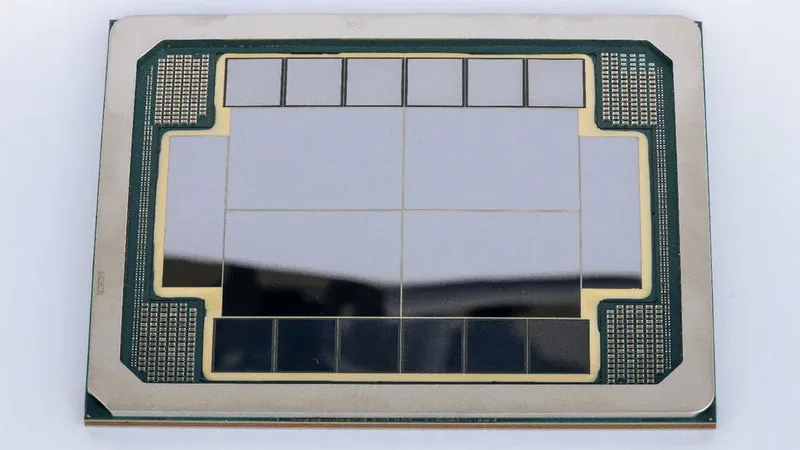
Intel has introduced a prototype of an advanced artificial intelligence (AI) chip, demonstrating significant progress in hardware design and packaging technologies tailored for AI and high-performance computing (HPC) workloads. The prototype features a notably large architecture that integrates four distinct logical blocks alongside twelve stacks of HBM4 memory, illustrating Intel Foundry’s cutting-edge capabilities.
The newly presented AI chip prototype showcases Intel’s evolving strategy in addressing the demanding requirements of AI applications. Central to its design is the use of multiple logical blocks, which likely enhance parallel processing abilities and overall throughput for AI tasks. Complementing the processing units, the integration of twelve HBM4 (High Bandwidth Memory generation 4) stacks provides a substantial memory bandwidth boost essential for AI and HPC performance.
This configuration marks a significant milestone in Intel’s packaging technology, enabling complex multi-die assemblies that combine processing elements with high-bandwidth memory in a single chip package. Such innovations are crucial for meeting the growing computational power expectations for modern AI models and extensive data analytics.
The revealed schematic aligns with Intel Foundry’s broader efforts to advance the semiconductor manufacturing process and hardware design tailored specifically for next-generation AI and HPC solutions. The company underscores its commitment to delivering integrated platforms that optimize performance, energy efficiency, and scalability through sophisticated chip architecture and packaging methods.
While detailed specifications, performance metrics, and commercial availability were not disclosed, the demonstration signals Intel’s continued investment in expanding its AI hardware portfolio. The chip’s design suggests a focus on scalable and modular architectures capable of handling increasing workloads seen in AI research, enterprise applications, and data center operations.
Intel’s approach, combining multiple logical processing blocks with extensive HBM4 deployment, reflects industry trends where memory capacity and access speed are just as critical as processing power for AI model efficiency. By pushing these technological boundaries, Intel aims to compete robustly in the growing field of AI accelerators and high-performance chips.
Overall, this prototype confirms that Intel is advancing toward producing highly integrated, powerful AI chips designed to keep pace with the complex demands of future artificial intelligence and computational needs.
Intel reveals a groundbreaking AI chip prototype with four logical units and a dozen HBM4 stacks, showcasing its hardware packaging expertise.