China Resumes Issuance of Robotaxi Licenses After Temporary Suspension
July 23, 2026
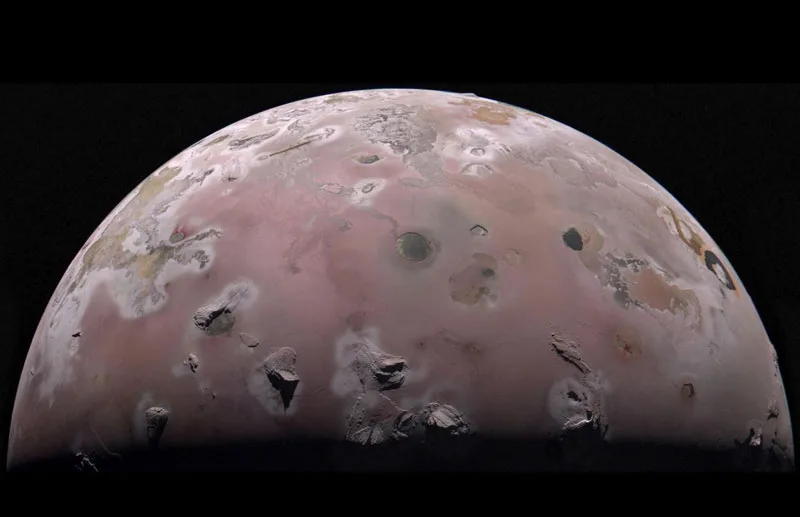
NASA’s Juno spacecraft has achieved a pioneering milestone by measuring the temperature beneath the surface of Io, Jupiter’s volcanic moon famed for its intense volcanic activity. This marks the first time scientists have obtained temperature readings not only from Io’s surface but also from its upper subsurface layers, shedding new light on its internal heat dynamics.
Io holds the distinction of being the most volcanically active object in the Solar System, with its landscape continuously reshaped by widespread volcanic eruptions. Previous observations primarily focused on surface temperature and volcanic plume activity. However, Juno’s recent data reveal that the moon’s interior, just a few meters below the crust, maintains significantly elevated temperatures. These findings confirm that Io’s heat is not confined to transient surface phenomena but is sustained within its subsurface layers.
This internal heating is driven by intense tidal forces resulting from Jupiter’s gravity, which cause frictional heating inside Io. Understanding the distribution and magnitude of this internal heat is essential for unraveling the moon’s geological processes and volcanic behaviors.
Juno’s advanced instruments to measure subsurface temperatures employ methods that were previously unutilized in the context of Io. The ability to detect thermal gradients beneath the surface provides crucial insights about the moon’s magma dynamics, heat flow, and potential subterranean activity.
Beyond Io, researchers highlight the broader implications of this technique. Scientists suggest that similar temperature measurement methods could be adapted for studying volcanic processes on Earth. Such applications could deepen understanding of terrestrial volcanism by revealing underground heat conditions and magma movement in ways that standard surface observations cannot capture.
The success of Juno’s subsurface measurements underscores the growing importance of innovative thermal sensing in planetary exploration. By extending investigation beyond surface phenomena, researchers can develop a more comprehensive picture of planetary interiors, contributing to comparative planetology and the study of geological evolution across different celestial bodies.
Although specific technical details and further analysis of the data remain forthcoming, Juno’s breakthrough paves the way for future missions aiming to explore volcanic activity and internal heating on other moons and planets. The observation of heat several meters below Io’s surface is a key step in refining models of tidal heating and its role in shaping the geology of moons in the giant planet systems.
NASA’s Juno spacecraft has, for the first time, measured the internal temperature of Io, revealing heating several meters below its surface.