
Memory Chip Makers Face Potential DRAM Oversupply by 2028 Amid Massive Capacity Expansions
July 20, 2026
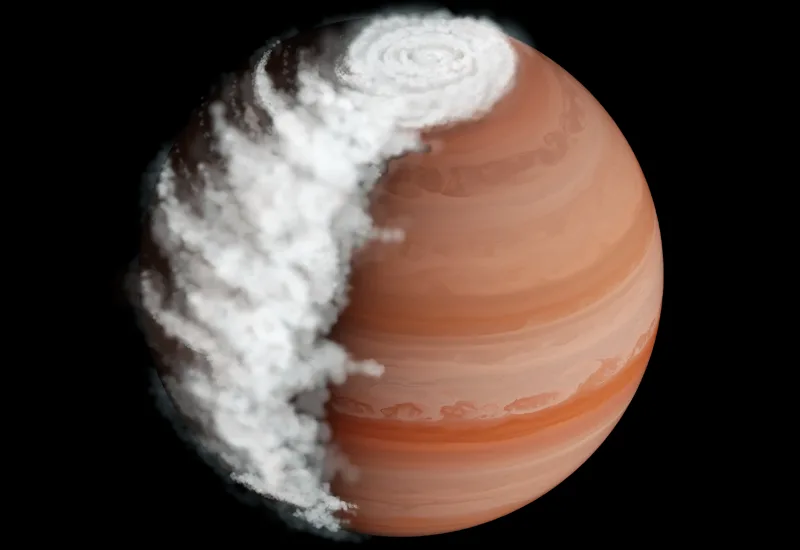
The James Webb Space Telescope, operated by NASA, has for the first time revealed a daily weather cycle on an exoplanet known as WASP-94Ab. This gas giant, classified as a “hot Jupiter” due to its close orbit around its host star and extreme atmospheric temperatures, exhibits a striking phenomenon involving clouds composed of evaporated magnesium silicate, a mineral closely related to terrestrial sand.
WASP-94Ab’s morning skies are characterized by thick clouds formed from silicate particles. These clouds form from magnesium silicate vapor, indicating a unique meteorological process that occurs as the planet rotates. Throughout the day, these mineral clouds gradually dissipate, leading to clear skies by evening. This daily cycle of cloud formation and dissipation had not been directly observed on exoplanets until now.
The clearing of the atmosphere by sunset provided astronomers with an unprecedented opportunity to study the planet’s atmospheric composition without the interference of thick clouds. The clear evening conditions allowed for the collection of unimpeded spectral data, helping scientists better understand the chemical processes and elements present in the atmosphere of a hot Jupiter.
Hot Jupiters like WASP-94Ab are gas giants that orbit extremely close to their stars, resulting in intense heating that can vaporize minerals typically found on rocky planets or moons. The presence of magnesium silicate clouds on WASP-94Ab confirms theoretical models suggesting that such mineral clouds can form and persist in these harsh environments, contributing to complex weather systems unlike anything seen in the Solar System.
This discovery underscores the expanding capabilities of the James Webb Space Telescope to probe detailed atmospheric phenomena on distant worlds, advancing the understanding of planetary weather beyond Earth. Such observations are crucial for broadening knowledge about planetary atmospheres, weather cycles, and their varying chemical compositions across the galaxy.
NASA’s James Webb Telescope observed daily weather cycles on hot Jupiter WASP-94Ab, revealing morning silicate clouds that clear by evening.