App Store Sees Surge in New Apps Amid Growth of No-Code Platforms in Early 2026
July 21, 2026
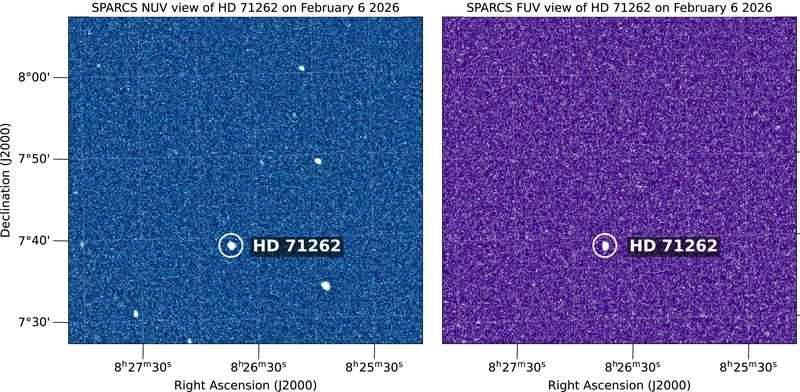
NASA has launched a new initiative aimed at assessing the habitability of extraterrestrial planetary systems within the Milky Way, focusing particularly on stars with low mass. This effort incorporates data from the recently operational SPARCS space telescope, which has delivered its initial images highlighting stellar conditions in environments where life could potentially develop.
The search for life beyond Earth increasingly centers on planets orbiting small stars, many of which share similarities with or are smaller than our Sun. These stars represent a substantial portion of the galaxy’s stellar population and may host billions of worlds within their habitable zones. However, the intense flare activity frequently exhibited by low-mass stars poses a significant challenge to the emergence and persistence of biological life on nearby planets.
Stellar flares can release powerful bursts of radiation and charged particles, which may strip a planet’s atmosphere or disrupt conditions necessary to sustain living organisms. Understanding this so-called “space weather” is critical for evaluating whether certain planets can maintain stable, life-supporting environments despite such fluctuations.
NASA’s latest observations with SPARCS are providing unprecedented insights into the magnitude and frequency of these flares. By monitoring the ultraviolet emissions from these distant stars, scientists hope to refine models predicting how stellar storms influence planetary habitability. This knowledge could help prioritize targets for future missions focused on detecting bio-signatures and potentially habitable exoplanets.
As the investigation progresses, NASA aims to compile detailed assessments of cosmic weather patterns across a variety of low-mass star systems. These findings will play an integral role in framing our understanding of where life might reasonably develop beyond our solar system and improve the strategies for its detection.
The initial SPARCS telescope images mark a significant step toward unraveling the complexities of life-supporting conditions in the galaxy, especially around the most common stellar hosts. Continued research is expected to deepen our comprehension of the delicate interplay between stellar activity and planetary environments, guiding future exploration efforts in astrobiology.
NASA uses the SPARCS space telescope to analyze stellar activity that may threaten life on planets orbiting low-mass stars.