Memory Chip Makers Face Potential DRAM Oversupply by 2028 Amid Massive Capacity Expansions
July 20, 2026
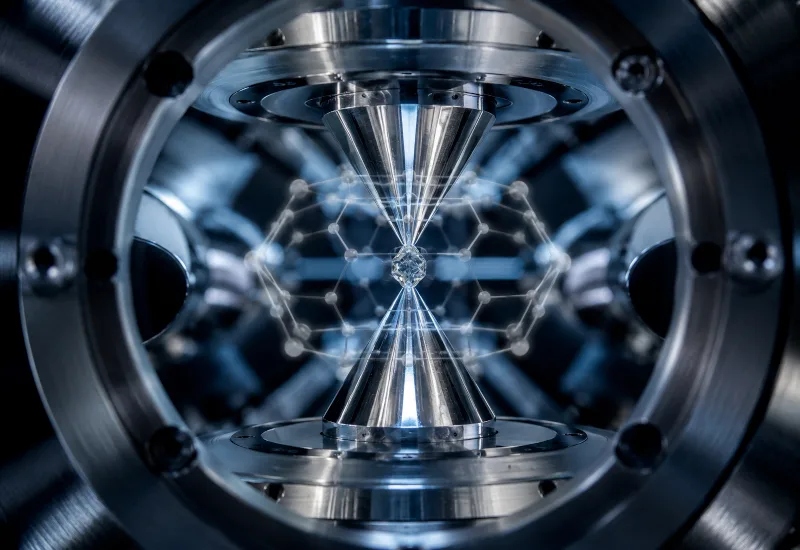
Scientists in China have conducted experiments revealing why diamonds exhibit reduced hardness when their size is minimized to the nanoscale. By compressing hundreds of nanodiamonds ranging from 4 to 12 nanometers in diameter within a vacuum, researchers observed a significant decrease in the materials’ resistance to compression.
The key finding indicates that as diamond crystals become exceedingly small—measured in billionths of a meter—their ability to resist deformation drops by approximately 30%. This phenomenon contrasts with the well-known robustness of bulk diamond materials.
Research attributed this softening to alterations in the atomic configuration at the surface of these microscopic crystals. Unlike larger diamonds, where the rigid internal lattice dominates, nanodiamonds have a substantially greater proportion of atoms at their surface. These surface atoms have different bonding arrangements, which weakens the overall structural integrity and reduces hardness under compression.
The experiment involved compressing nanodiamonds that are hundreds of times smaller in scale than many viruses, highlighting the extreme reduction in size required to observe these changes. Conducting the measurements in a vacuum ensured that external environmental factors did not influence the intrinsic properties of the crystals.
This study advances the understanding of mechanical properties at the nanoscale level, which can influence applications in nanotechnology, materials science, and possibly the development of diamond-based nanoscale devices where mechanical durability is critical. Further research may explore how surface treatments or structural modifications could counteract the size-dependent softening phenomenon observed.
A study reveals that nanodiamonds lose stiffness as their size decreases due to changes in atomic surface structure.