Vertical Aerospace’s eVTOL Aircraft Achieves Manned Test Flight, Advancing Certification Progress
June 12, 2026
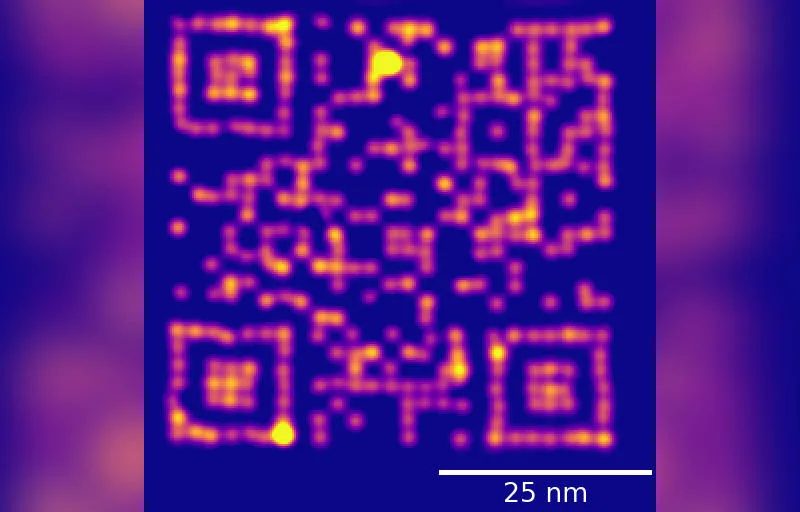
In a groundbreaking development in nanotechnology, researchers from Monash University’s School of Physics and Astronomy in Australia, working alongside the Czech Academy of Sciences, have engineered the smallest QR code ever recorded. The code is constructed by precisely positioning individual silver atoms, achieving a scale nearly 800 times smaller than the previous smallest known QR code.
This innovative feat involves arranging atoms of silver in a pattern that can be recognized as a QR code, representing a significant advancement in microscopic data encoding and storage. While QR codes are typically composed of square-shaped modules visible to the naked eye or through standard imaging devices, this novel approach integrates atomic-scale elements to encode information.
The technique used to produce this minuscule QR code relies on state-of-the-art atomic manipulation, allowing researchers to position each silver atom with exceptional accuracy. This precise control paves the way for ultra-high-density data storage methods and offers new possibilities for encoding information in materials at the atomic level.
Although practical applications of such a tiny QR code are still emerging, this discovery showcases the tremendous potential of atomic-scale engineering. It marks a significant milestone in the quest for miniaturizing data storage and the enhancement of information technologies that depend on molecular and atomic structures.
The collaboration between Monash University and the Czech Academy of Sciences exemplifies the importance of international partnerships in pushing the boundaries of scientific research. Their success not only challenges existing limits in nanotechnology but also may influence future developments in secure data authentication, advanced material science, and nanoelectronics.
Further details regarding the functionality and potential commercial use of this atomic-level QR code have yet to be disclosed, but the achievement highlights the rapid progress in precision engineering and quantum-level material manipulation.
Scientists from Monash University and Czech Academy of Sciences have developed the tiniest QR code ever, made from single silver atoms.